Truthfully, I was a little nervous of traveling to Madrid. I only knew a little Spanish and also had heard horror stories of being pick-pocketed. I'm glad to say I was completely wrong. Madrid is an amazing city both historically and culturally.
Madrid is a huge city. It is a great walking city where you can take in the atmosphere that is Madrid. Also, if you become tired, it's easy to take a taxi (taxi fares are reasonable).

Plaza Major. The first of many plazas that I explored in Madrid.

King Phillip III's Bronze Statue created by Jean Boulogne and Pietro Tacca in 1616.
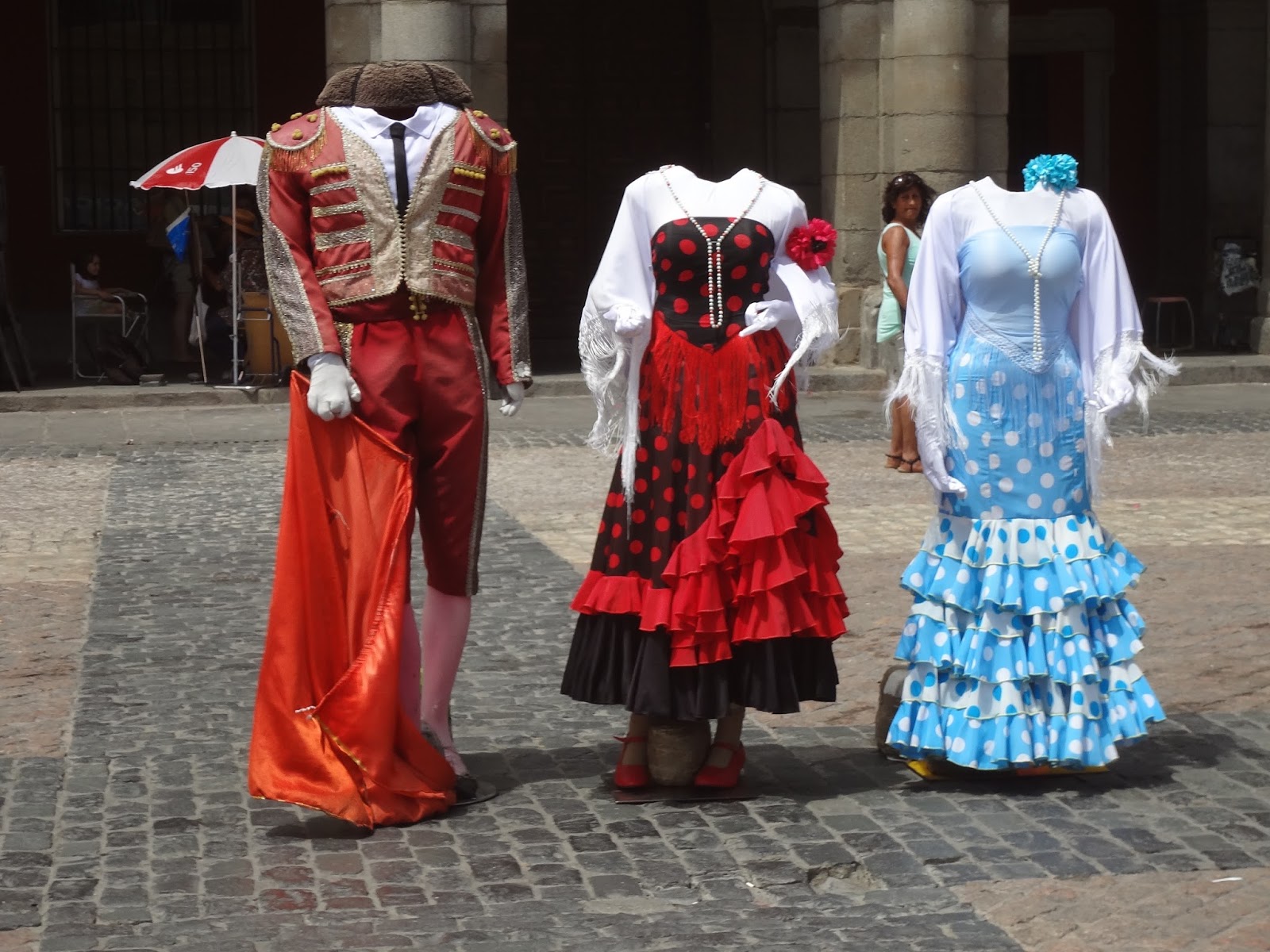
Traditional Flamenco Costumes on display in the Plaza Major.
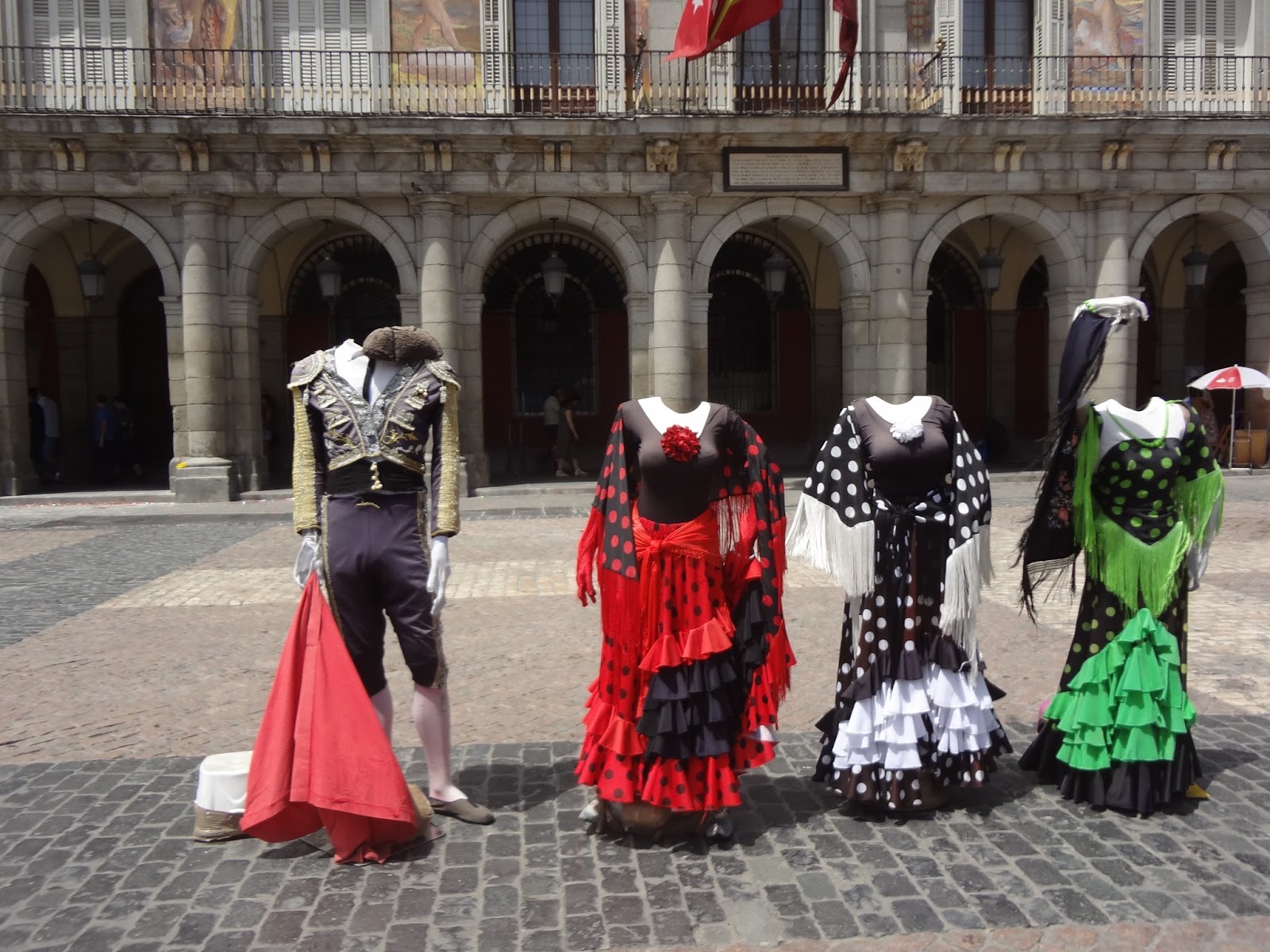
So, that is what I did for the first few days in Madrid. Just walking and exploring. There is truth in the saying that you have to walk through a city to know it. You can feel the energy and love of life that the people in Madrid have.

Puerto de Alcalá, a neoclassical monument, in Plaza de la Independenicia. Around 1774, it was commissioned by King Charles III. Francesco Sabatini constructed the gate in the city wall through which an expanded road to the city of Alcalá was to pass, replacing an older, smaller, gate which stood nearby. It was inaugurated in 1778.
The Prado is one of the three famous (Prado, Reina Sofia, and the Thyssen-Bornemisza) art museums in Madrid. These three museums are known for their extensive art collections and masterpieces by famous artists such as Picasso, Goya, and Titian just to name a few.

The entrance to the Prado.
Guidebooks recommend to keep a half day open to explore each museum. They weren't kidding. I spent four hours in the Prado alone.
The museum doesn't allow photos which I personally like. This made it easier to take time to appreciate and enjoy the artwork.
I was also able to see the Reina Sophia while I was in Madrid. The Reina Sophia houses an extensive art collection, including Guernica by Picasso.
The next day I visited Retiro Park. Originally owned by the Spanish Monarchy, it became a public park in the 19th century. The park is filled with statues, fountains, museums, and a large lake where you can paddle boat.

One of the statues in the park.

Statues lining each side.

Seriously, this park is huge.

The Crystal Palace. One of the free museums in the park.

In the Crystal Palace, there was a Bedouin Tent Display. It was so colorful.

One of the Fountains

The pretty lake were you can rent paddle boats.

Behind a waterfall in the park.
I loved exploring the park. Like Central Park in New York City, it's amazing to see so much greenery in a stone and brick city.
The next day I went to Toledo which is about 30-40 minutes by train. It used to be the original capital of Spain before it moved to Madrid. I'm not going to go into any more detail about Toledo here because the next blog post will be dedicated to the day trip there. Here's a sneak preview:

The City of Toledo
The day after visiting Toledo, I continued my site-seeing around Madrid. My first stop was the Palace. The Royal Palace is the official home of the Spanish Royal Family but is now only used for state ceremonies. King Juan Carlos, the father of the current king, brought Democracy to Spain after dismantling the Francoist regime. The Palace is now owned by the Spanish State, and rooms are open to the public for viewing.

The Royal Palace

From the oriel: a balcony that overlooks the main staircase inside the palace.

Baroque Vaulted Ceiling painted by Corrado Giaquinto in 1759 on the theme of: The Triumph of Religion and the Church.
The main staircase was the only area where pictures were allowed. These pictures only give a glimpse of the magnificence the palace has to offer. For example, there is a room made entirely of porcelain.
My next stop was the Temple of Debod. The Temple of Debod is an ancient Egyptian temple that was dismantled and relocated to Spain as a sign of gratitude for Spain's help in saving the temples of Abu Simbel.

As a fan of Egyptology and never having visited Egypt, I had to see this.
The following day, I attempted to find the famous nuns who sell their baked goods. Unfortunately, by the time I found the entrance, the nuns had closed for prayer. However, I purchased some of their baked goods from a nearby store.
My next stop was the infamous bullfighting bar, La Torre del Oro. The bar is decorated with pictures and memorabilia from bullfights. Some of the pictures are shocking since several show matadors being gored by bulls.

The interior of La Torre del Oro
After visiting the bar, I decided to see the bullfighting ring itself. The controversial bull fights still continue on Sundays at the ring. Whether you support bullfighting or not, it is an important part of Spanish history.

Outside the ring.
I personally can't watch a bull being killed, but seeing the bullfighting ring was fascinating. It reminded me of the football stadiums we have in the United States.
That night I decided to go to Corral de la Moreria to eat dinner and watch the flamenco performers. Flamenco is a genre music and dance native to Southern Spain. There are over 50 different styles of Flamenco.

The singers and the dancers

Pictures do not capture the energy and drama of the performers.
The Flamenco is a magical dance. Watching it, you are swept up in the singers' and dancers' energy. When I left that night, I was energized from the experience. It is definitely worth watching the Flamenco, whether in the famous Corral de la Moreria or at a Flamenco bar at 1 am.
Usually, this is where I wrap up my entry about my adventure and then briefly show pictures of the great food I ate. However, I felt that this time I needed to write a preface.
Spanish cuisine is unique. With several different regions that have their own style of cooking, you're bound to gain a few pounds simply from indulging in everything.
First up is Basque Cuisine. I went to Zalacain which specializes in Basque cuisine. The cuisine is influenced by the produce from the sea on one side and the Ebro valley on the other.

One of the samplers

A salad

Sole that practically melted in your mouth

One of the sample deserts they give you.

This one was filled with almonds.

I ordered the fresh strawberries with cream. So amazing.
Tapas are also common. Tapas are a wide variety of appetizers, or snacks in Spanish cuisine. They can be served hot or cold. Since dinner in Madrid isn't eaten until 9 at the earliest, tapas are light meals that keep you satisfied. Tapas are meant to encourage conversation between people since you aren't focused on an entire meal. Also, tapas crawls are common. It turns eating into a fun experience.

Croquettes are amazing and a common form of Spanish Tapas. The ones on the left were filled with salt cod, the ones in the center were filled with squid, and the ones on the right with ham. The cod and ham were great, the squid unfortunately wasn't my favorite.

Prawns wrapped in potato strings with Mango and Greek yogurt sauce. Yum!

Spain is known for its hams. In this tapas dish, I had a selection of Iberian ham, cured loin, chorizo, and sausage. The Iberian Ham lives up to its fame. It was delicious.

Iberian ham and cheese tapas.
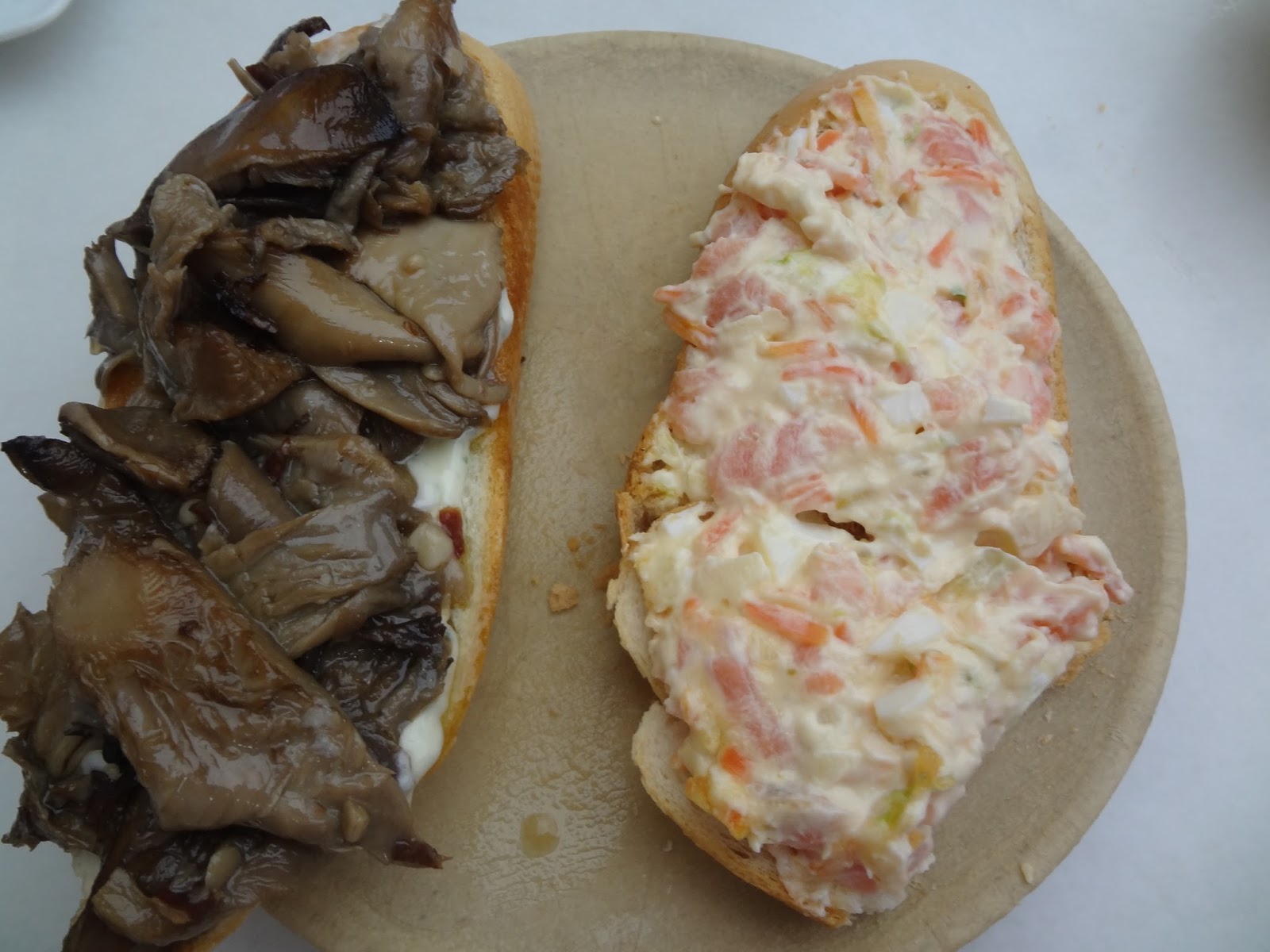
The one the left had mozzarella and anchovies. I'm surprised to say that I am now a fan of anchovies. They are salty and yummy.

Figs with blue cheese.
Finally, here are few more amazing foods/ drink I sampled while in Spain. Some were Spanish cuisine; some weren't. However, all were delicious.

One of the dishes I ordered at the Botin Restaurant, the oldest restaurant in the world.

Seafood Paella. They are several different versions in Spain. This one was delicious and filling. It's meant for at least 2 to 3 people.

After dinner, the waiter told me to drink a shot of each. The one on the right reminded me of limoncello while the one on the left had a chocolate taste. It was an interesting combination.

Salmon from the Corral de la Moreria

Spanish Omelette

In Spain, they drink Vermouth by itself. So, naturally I had to try it.

The Caipirinha is actually the national drink of Brazil. I've always wanted to drink it so when I found a restaurant that made them, I ordered one. It is made with cachaca, sugar, and lime.

Another drink I've wanted to try was the Brandy Alexander. It is a brandy-based cocktail consisting of cognac and creme de cacao.
Madrid was an amazing experience, full of culture and history. Madrid is definitely worth visiting. Best of all, my trip ended with my script receiving an award at the Madrid International Film Festival!

Un-produced Script Award Winner
Stay tuned for my next post on Toledo!
~A.E. Keener
Want to learn more about my adventure? Follow the links below:
~Madrid International Film Festival:
~Westin Palace Hotel:
~Prado Museum:
~The Reina Sofia Museum:
http://www.museoreinasofia.es/en ~Royal Palace of Madrid:
http://www.patrimonionacional.es
~Bullfighting Ring:
http://lasventastour.com/en/
~La Torre del Oro:
http://www.torredeloro.wellsoc.org
~ Corral de la Moreria:
http://www.corraldelamoreria.com/en/index.html
~Botin Restaurant:
http://www.botin.es/?q=en
~Zalacain:
http://www.restaurantezalacain.com/ingles/Restaurante_Zalacain/menu.html